Dead Companies
The full story
The memo
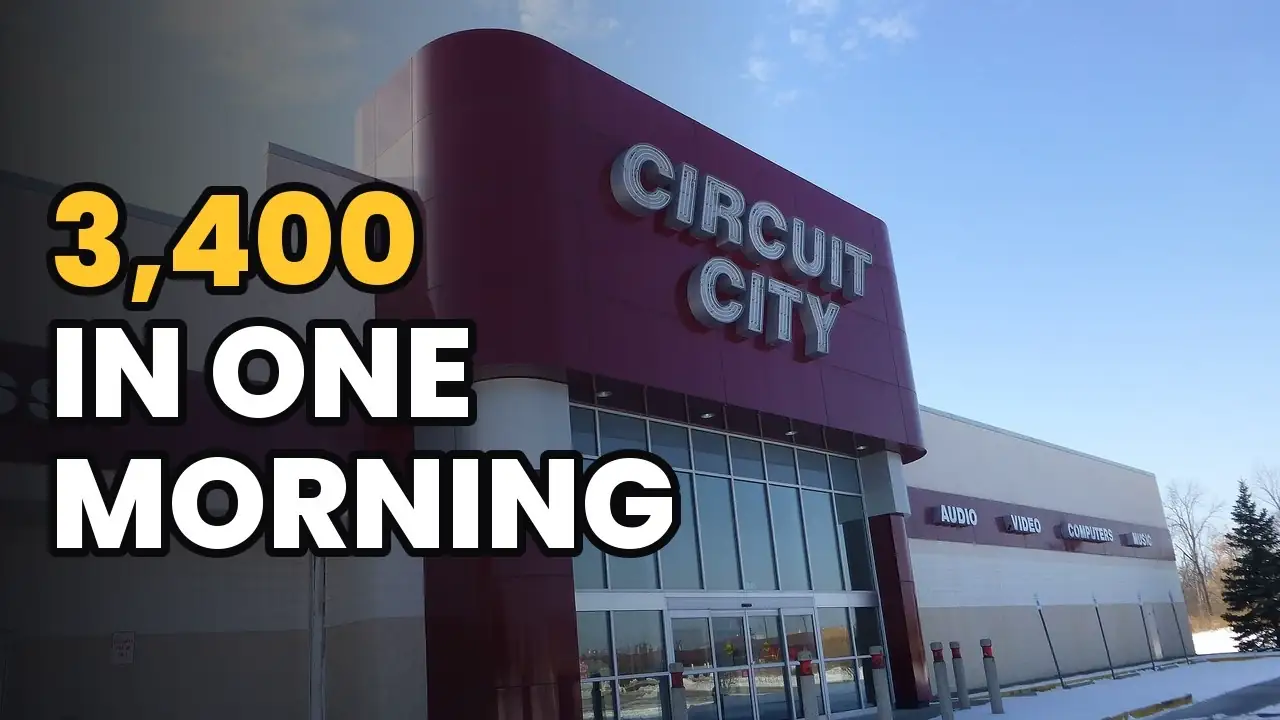
On the morning of March twenty-eighth, 2007, three thousand four hundred Circuit City employees were called into back rooms across America and told they no longer had a job.
They had not done anything wrong. They were fired because they were the best. The company announced it was letting go of its highest-paid store staff, and replacing them with cheaper new hires.
The company said it would save money. Wall Street cheered for about a week. Then the customers walked in, asked a question about a television, and nobody could answer it.
Within two years, Circuit City did not exist. But the firing was not the cause. It was the symptom of something that had been going wrong for a decade.
The TV shop
In 1949, a man named Samuel Wurtzel was getting a haircut in Richmond, Virginia, when his barber mentioned that television was coming to the South. Wurtzel opened a store to sell TVs that same year.
He called it Wards, from the initials of his family. For twenty years it sold televisions and appliances from small shops. Then his son, Alan, took over in 1972 and had a bigger idea.
Alan Wurtzel built the electronics superstore. A giant warehouse of TVs, stereos, and video recorders, with trained salespeople on commission who could explain all of it. In 1984, the company renamed itself Circuit City.
Greatness
It worked spectacularly. From 1982 to 1997, Circuit City stock beat the overall market by more than eighteen times.
In 2001, the author Jim Collins published a book called Good to Great. It studied eleven companies that had made the leap from ordinary to extraordinary. Circuit City was one of them.
By the fiscal year ending in early 2007, Circuit City was selling about twelve billion dollars of electronics a year through more than six hundred stores. It was the second biggest electronics retailer in America.
The warnings
But look closer at those years, and the cracks were already there. In 1998, Circuit City launched DIVX, a rental disc that self-destructed after two days. Customers hated it. It died in 1999 and cost the company more than one hundred million dollars.
In 2000, Circuit City stopped selling appliances. Refrigerators and washing machines were low margin and heavy to deliver. The decision looked clean on a spreadsheet. But appliances were why many families walked in the door.
In 2002, it spun off CarMax, the used-car business it had invented. CarMax went on to become one of the most successful retailers in America. Circuit City kept the stores.
And then there was Best Buy. The Minnesota rival had dropped commissioned sales in the 1990s, built newer stores in better locations, and was growing faster every year.
Location, location
Here is the quiet killer. Circuit City had built many of its stores in the 1980s and 1990s, on cheaper land, off the main roads, often beside the highway rather than the shopping center.
Shoppers went where the other shops were. Best Buy built next to the mall. Circuit City was a destination you had to choose. By the mid 2000s, fewer and fewer people chose it.
The company knew this. Executives talked about relocating hundreds of stores. But moving a store costs millions, and there were hundreds of them. They never caught up.
The purge
So in 2007, under a new chief executive, Circuit City reached for the fastest savings it could find: its own payroll. The best salespeople earned the most. They would be the first to go.
The three thousand four hundred fired workers were about eight and a half percent of the store workforce. They could reapply for their old jobs after ten weeks, at lower pay.
The people who remained learned a lesson: being good at your job was dangerous. Morale collapsed. Service collapsed. And the customers, who had come for advice on expensive televisions, noticed.
That Christmas, sales at existing Circuit City stores fell more than eleven percent. By the end of the year, the stock had lost about eighty percent of its value.
The last offer
In the spring of 2008, a surprising buyer appeared. Blockbuster Video, itself in trouble, offered more than a billion dollars for Circuit City.
Circuit City refused to open its books. By July, Blockbuster walked away. It was the last offer anyone would make for the whole company.
Then, in September 2008, the financial crisis hit. Credit froze. Suppliers who shipped televisions on credit wanted cash up front. Circuit City did not have it.
On November tenth, 2008, Circuit City filed for bankruptcy. It closed one hundred fifty-five stores immediately and hoped to survive the holidays.
It did not. Sales in the bankrupt stores fell by up to half. On January sixteenth, 2009, Circuit City announced it would liquidate everything. Five hundred sixty-seven stores. Thirty-four thousand jobs.
The last store closed on March eighth, 2009. Creditors were owed about one point two billion dollars. It took until 2021, twelve years later, for them to get back fifty-five cents on each dollar.
The other ending
Now the twist. Best Buy faced the same crisis, the same frozen credit, the same nervous shoppers in the winter of 2008. It lived.
Best Buy had about one thousand stores in good locations, a working website, and staff who stayed. When Circuit City died, its customers walked across the parking lot and kept buying.
Alan Wurtzel, the son who built the superstore, later wrote his own book about the company his father founded. He titled it Good to Great to Gone.
The verdict
His verdict was simple. The collapse was not inevitable. The company had lost its way long before 2008. By the time it fired its best people, it was already too late.
Jim Collins himself later wrote a follow-up book about how the mighty fall. Circuit City was in that one too, this time as an example of what not to do.
The Circuit City name was later sold and revived as an online store. The buildings became gyms, grocery stores, and empty lots. The company that invented the electronics superstore left no stores behind.
So did Circuit City die because of the 2008 crash? No. The crash only ended it. It died because, year after year, it chose the spreadsheet over the reason customers walked in. Once it fired the people who were that reason, only boxes remained.