Dead Companies
The full story
The last flight
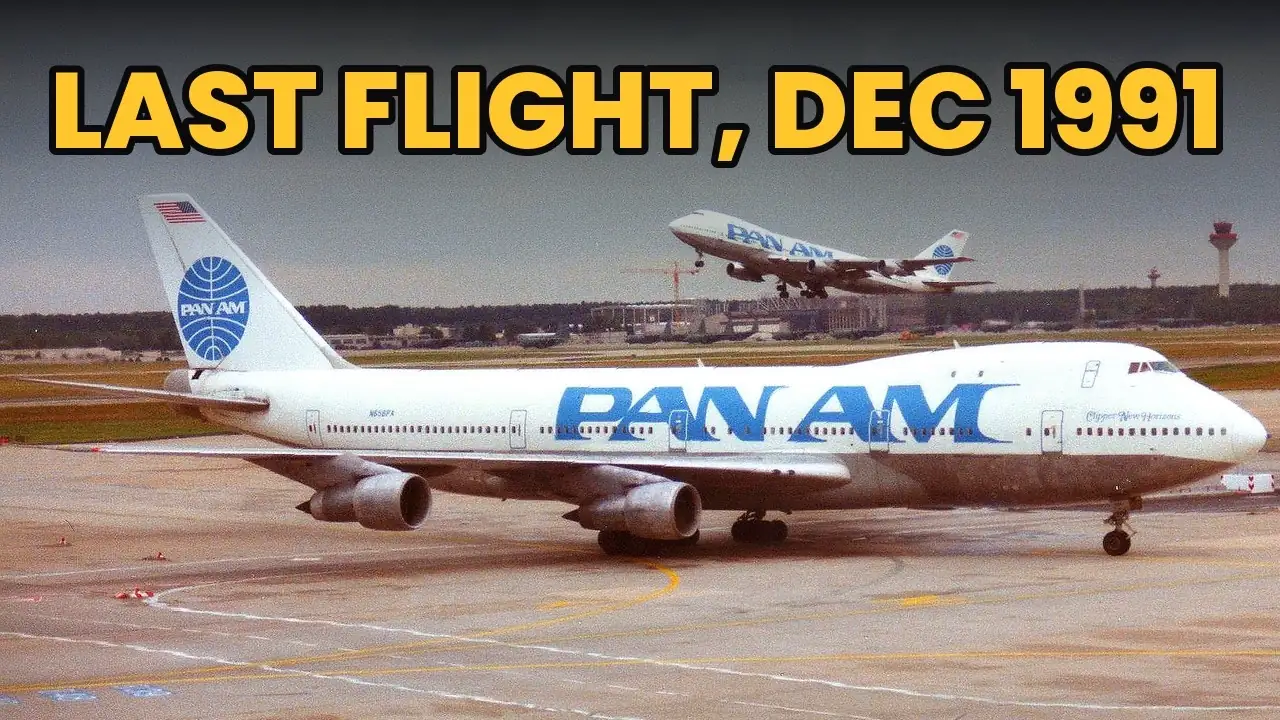
A Pan Am jet is high over the Caribbean, flying from Barbados to Miami. Before takeoff, the captain got the news. The airline he is flying for no longer exists. This is Pan Am's final flight.
It is December fourth, 1991. For sixty-four years, Pan Am had been the most famous airline on Earth. It launched the jet age and the jumbo jet, and sold the world the idea that anyone could fly anywhere.
The popular story says a bomb over Scotland killed it. That is not what happened. Pan Am was already dying, killed by a gift the government had given it decades earlier. By the end, you will see how that gift became its sentence.
The chosen instrument
In 1927, a young Yale graduate named Juan Trippe won a contract to fly mail ninety miles from Key West to Havana. The first flight carried sacks of letters and not a single passenger.
Trippe did not want to be an airline. He wanted to be the airline. Through the 1930s his giant flying boats, the Clippers, crossed the Pacific and the Atlantic, landing in harbors no runway had ever reached.
Washington liked the arrangement. Pan Am became America's chosen instrument abroad, with near-exclusive rights to fly overseas. In return, there was a catch. Pan Am was not allowed to fly inside the United States.
Think about what that meant. Every other big airline fed its overseas flights with passengers from dozens of American cities. Pan Am started every journey at the water's edge, with nothing behind it.
The jet age
For decades the catch did not matter, because Pan Am was the future. In October 1958 it flew the first Boeing seven-oh-seven across the Atlantic, New York to Paris, and cut the crossing nearly in half.
In 1963 it opened the biggest office building in the world above Grand Central Station in Manhattan. Pilots were celebrities. The blue globe on the tail meant you had arrived.
Then Trippe made the biggest bet in aviation history. He ordered twenty-five Boeing seven-forty-sevens before the plane existed, for more than five hundred million dollars. In January 1970 the jumbo jet carried its first passengers from New York to London.
The seven-forty-seven doubled the seats on every route, and Pan Am had to fill them. Then the 1973 oil crisis sent fuel prices soaring while traffic stalled. The giant planes flew half empty.
The ground shifts
In 1978 Congress deregulated the airline industry. Any airline could now fly anywhere, including overseas. Pan Am's precious monopoly evaporated overnight.
Worse, rivals could now do what Pan Am never could. United, American and Delta flew a passenger from Omaha to Chicago to London on one ticket. Pan Am could only offer the last leg.
So in 1980 Pan Am did something desperate. It bought a domestic airline, National, in a bidding war, for more than four hundred million dollars. National's routes ran mostly between Florida and the Northeast, and connected to almost nothing Pan Am flew.
The purchase cost almost exactly what Pan Am got the same year for selling its own headquarters. Different planes, different unions, different cultures. The merger lost money from the first day.
Selling the silver
What followed was a decade of selling the family silver to cover the losses. In 1980 the Pan Am Building went to an insurance company for four hundred million dollars.
In 1981 the Intercontinental hotel chain, the most profitable thing it owned, went for five hundred million. In 1985 Pan Am sold its entire Pacific division to United for seven hundred fifty million dollars.
The Pacific was the route network Trippe had built with flying boats fifty years earlier. Each sale bought another year or two. Each one left a smaller airline with the same enormous costs.
By the mid-1980s Pan Am was flying an aging fleet with some of the highest labor costs in the industry, in a market crowded with competitors who had the feeder networks it lacked.
Lockerbie
Then came the night of December twenty-first, 1988. Pan Am Flight one-oh-three, bound from London to New York, exploded over the Scottish town of Lockerbie. Two hundred seventy people died.
A bomb hidden inside a cassette player had been loaded onto the plane in Frankfurt. Investigators found Pan Am's security had ignored its own rules. A jury later found the airline guilty of willful misconduct.
Transatlantic bookings collapsed. Then in August 1990 Iraq invaded Kuwait. Oil prices doubled, and when the Gulf War began, Americans simply stopped flying to Europe.
The end
On January eighth, 1991, Pan Am filed for bankruptcy. To keep flying it sold its London Heathrow routes to United for two hundred ninety million dollars, the crown jewels of the Atlantic.
Delta stepped in with a rescue. It would buy the transatlantic routes, the Northeast shuttle and dozens of planes for about one point four billion dollars, and keep a smaller Pan Am alive in Latin America.
It lasted weeks. The new Pan Am burned cash faster than anyone had forecast. On December third Delta told the court it would not put in another dollar.
The next morning, December fourth, 1991, Pan Am stopped flying. Thousands of employees were sent home. That last flight from Barbados landed in Miami, and its crew were met on the tarmac by weeping colleagues.
The twist
Here is the twist. Lockerbie, the Gulf War, even the National merger were not the disease. They were symptoms of a company that had been built upside down.
An airline's profit comes from its network. A passenger in Kansas City flies to Europe only if the same airline can get her to the gateway. Pan Am had the gateways, the planes and the brand. It never had Kansas City.
The monopoly that made Pan Am great forbade it from building the one thing that would have saved it. When the protection ended in 1978, Pan Am was a magnificent bridge with no roads leading to it.
Trippe himself saw the danger. For decades he lobbied Washington for domestic routes, and was refused every time. The gift that made Pan Am was also its sentence.
What remained
The name was sold at auction and used by two small airlines that both failed. Today the globe logo lives on T-shirts and bags, a fashion brand for an airline that no longer flies.
In Lockerbie, a memorial garden holds the names of two hundred seventy people. The Pan Am Building still stands above Grand Central, with a different name on the roof.
The seven-forty-seven that Pan Am gambled everything on flew for another fifty years for other airlines. Boeing built more than fifteen hundred of them. The last one left the factory in 2023.
So did Pan Am die because of a bomb over Lockerbie? No. It was built in 1927 as a bridge to the world, and forbidden to build the roads leading to it. When the rules changed in 1978, it was fifty years too late.