Dead Companies
The full story
The clone
In the summer of 2003, a few employees at an internet marketing company in Los Angeles copied a website. Their bosses sold pop-up ads and spyware, and they wanted a social network. It took about ten days.
The site they copied was Friendster. The copy was called MySpace. Within three years it would be the most visited website in America, bigger than Google. Within eight it would sell for less than a Manhattan penthouse.
The popular story says Facebook killed MySpace. That is not what happened. MySpace was killed by the best business deal it ever signed.
Tom
The founders were Chris DeWolfe, a marketer, and Tom Anderson, a musician with a film degree. Every new user got an automatic first friend: Tom, smiling over his shoulder in a white T-shirt. Soon Tom had more friends than anyone in history.
Friendster had rules and crashed constantly. MySpace had neither. You could paste any code into your profile, play any song, and be anyone you wanted. Teenagers and bands moved in by the millions.
Garage bands used it to book tours. Shy kids used it to become someone else. By 2005 MySpace was adding accounts faster than anyone could count, and the man who owned Fox News noticed.
Rupert Murdoch had watched his newspapers lose readers to the internet. MySpace was his answer. In July 2005 News Corporation bought it, with its parent company Intermix, for five hundred eighty million dollars.
The peak
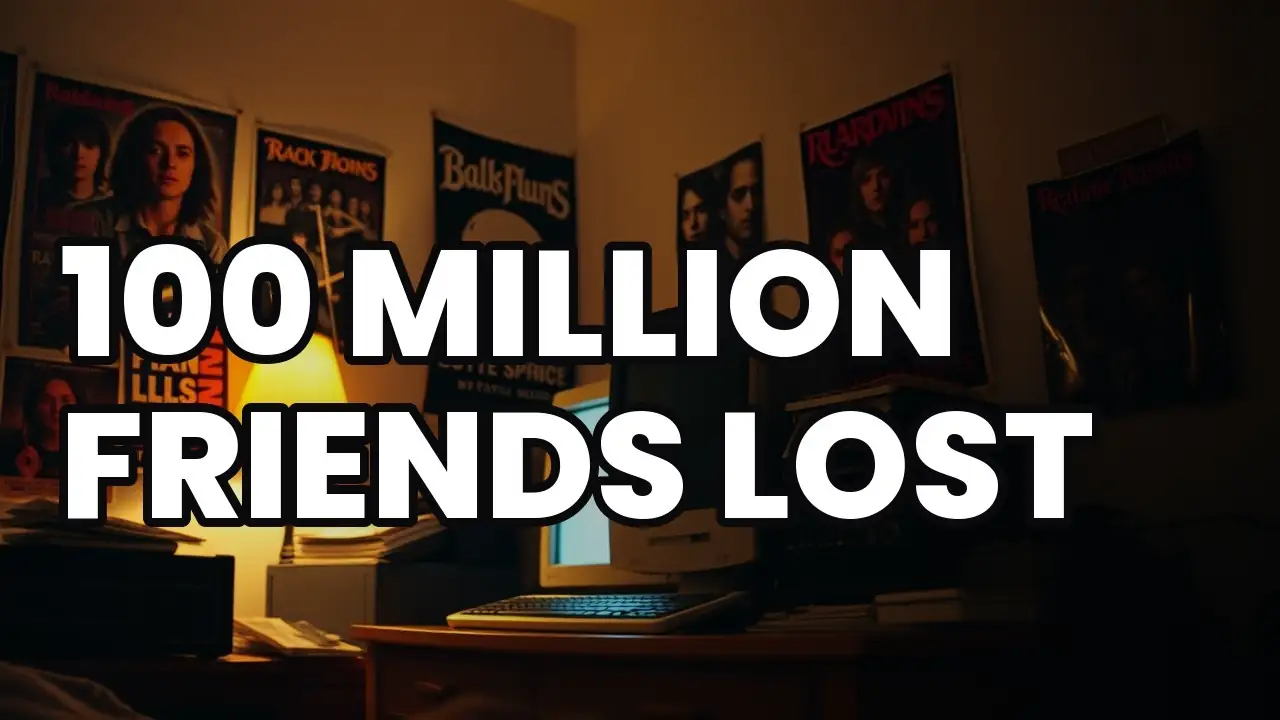
In June 2006, MySpace passed Google to become the most visited website in the United States. That August, the one hundred millionth account was created.
Four out of five visits to any social network in America went to MySpace. It was not the biggest social network. It was, for a moment, the only one that mattered.
Then came the deal of the decade. In August 2006 Google agreed to pay MySpace nine hundred million dollars over three years to run its search and ads. That alone was worth more than News Corp had paid for the whole company.
In 2007, during merger talks with Yahoo, News Corp valued MySpace at around twelve billion dollars. Up in Palo Alto, Facebook, which started as a college site, had a fraction of the users.
The fine print
Here is the part everyone forgets. The nine hundred million was not a gift. It was a guarantee with conditions. MySpace had to deliver a minimum amount of traffic, every quarter, or the money stopped.
So every decision now pointed one way. More page views. More ads per page. More clicks. The site that had won by letting users do anything became a machine for showing them advertisements.
Pages became slow and cluttered. Spam profiles multiplied. The customizable pages that had made MySpace feel like your bedroom wall now took half a minute to load and were covered in banners.
A former executive later admitted it plainly. The Google deal was a short-term cash windfall and a long-term handicap. MySpace had sold its future to hit a quarterly number.
Meanwhile
Meanwhile, in 2007, a company with about twenty million users made a decision MySpace never could. Facebook opened its platform to outside developers. Within months, thousands of apps and games appeared on Facebook pages.
Facebook's engineers shipped features weekly. MySpace was now a division of a media conglomerate, where a new feature needed approval from New York. Engineers who left described a company run by ad salesmen.
In October 2007 Microsoft bought a tiny stake in Facebook that valued it at fifteen billion dollars. For the first time, the former college site was worth more than MySpace.
The crossing
In April 2008 Facebook passed MySpace in worldwide visitors. MySpace executives were unbothered. They still led in America, and America was where the ad money was.
In October 2008 MySpace hit its peak: about seventy-six million monthly users in the United States, and about eight hundred million dollars in revenue that year. It would never have a better month.
In May 2009, Facebook took the lead in America too. Nobody at MySpace had a plan for what happened next, because nobody had believed it could happen.
Freefall
A month earlier, in April 2009, News Corp had pushed out Chris DeWolfe and hired a former Facebook executive to fix MySpace. Within two months he had laid off thirty percent of the staff. He lasted ten months.
Redesign followed redesign. In 2010 MySpace declared it was no longer a social network at all, but a social entertainment destination for music. The users it was trying to keep had already gone.
In 2010 the Google deal expired, and with it the money. By the spring of 2011 Facebook had more than four times MySpace's American audience, and Murdoch put the site up for sale, asking for one hundred million dollars.
In June 2011 the buyer was an advertising network called Specific Media, with the singer Justin Timberlake as a partner. The price was about thirty-five million dollars. News Corp had paid five hundred eighty million.
Half of the remaining staff were let go on the day of the sale. Murdoch later admitted, in a single sentence, that his company had screwed up MySpace in every way possible.
Afterlife
MySpace did not disappear. It relaunched in 2013 as a music site, was sold again in 2016 to the publisher of Time magazine for eighty-seven million dollars, and was folded into an ad technology company.
Then, in 2019, came the final insult. MySpace admitted that a server migration had wiped every photo, video and song uploaded before 2016. Twelve years of music from fourteen million artists, more than fifty million songs, gone. No backup.
Tom Anderson, the first friend of a hundred million people, left in 2009 and became a travel photographer. He is, by most accounts, one of the few people who came out of MySpace happy.
The twist
Now here is the twist. Facebook did not beat MySpace with better technology. In 2006, MySpace had more users, more money, more engineers and a bigger brand. It had every advantage but one. It could not think past this quarter's traffic.
The nine hundred million dollar deal was celebrated as the moment MySpace paid for itself. It was really the moment MySpace stopped being a product and became an inventory of ad slots. Users can feel that. They left.
Facebook, meanwhile, was private, unprofitable, and free to make its pages cleaner and faster and give them away to developers. It optimized for the user. MySpace optimized for the advertiser. One compounds. The other decays.
The lesson outlived the company. Every social network since has faced the same choice between the user and the quarter, and every one has eventually felt the pull that broke MySpace.
So did MySpace die because Facebook was better? No. It died in August 2006, the day it signed a nine hundred million dollar contract to show more ads to people who only came to see each other. Facebook walked in after the lights went out.