Dead Companies
The full story
The handshake
In April 2001, the second-largest bookstore chain in America signed a deal with a website that was losing money. Borders agreed to shut down its own online store and let Amazon run it instead.
Amazon would own the inventory, the shipping, the customer list, and every sale. Borders would get a small referral fee, and the right to stop worrying about the internet.
Borders executives called it smart. They were a bookstore, not a tech company. Why fight a battle you can outsource?
Ten years later, Borders was dead, and Amazon was the most valuable retailer on Earth. But the story of why Borders died is not the one most people tell.
Two brothers
It started in 1971 in Ann Arbor, Michigan. Two brothers, Tom and Louis Borders, opened a used bookstore on State Street, across from the university.
Louis had studied mathematics. He wrote a software system that predicted exactly which titles each neighborhood would buy. In a business run on hunches, Borders had a machine.
That machine let Borders stock more than one hundred thousand titles in a single store, with a coffee shop and chairs where you could sit and read for hours. It was a library you could buy from.
The empire
In 1992, the retailer Kmart bought Borders and merged it with Waldenbooks, the mall bookstore chain it already owned. In 1995, the combined company was spun off and listed on the New York Stock Exchange.
By 2003, Borders Group ran one thousand two hundred forty-nine stores across the United States, Britain, Australia, and beyond.
By 2006 it was selling four billion dollars of books, music, and movies a year. It was the second biggest bookseller in America, behind only Barnes and Noble.
The first mistake
Here is the number that explains the Amazon deal. In its last full year running its own website, Borders sold about twenty-seven million dollars online. The same year, Amazon sold nearly three billion.
To Borders, the website looked like a rounding error. Why pour money into something worth less than one percent of sales? Better to hand it to the experts and collect a fee.
But every customer who typed Borders dot com was now sent to Amazon. Borders was training its own shoppers, millions of them, to buy from its competitor. And it was being paid pennies to do it.
The second mistake
While Amazon learned who bought what, Borders doubled down on the physical store. It stocked huge sections of CDs and DVDs, which had been reliable sellers for years.
In 2003, Apple opened the iTunes store. Music went digital almost overnight. Borders was left holding entire floors of discs nobody wanted, in stores with twenty-year leases.
The leases were the trap. Borders had built enormous stores, often twenty-five thousand square feet, and signed long contracts to keep them. When sales fell, the rent did not.
Meanwhile, Borders had expanded overseas. The British and Australian stores lost money, and in 2007 the company began selling them off to raise cash.
Waking up
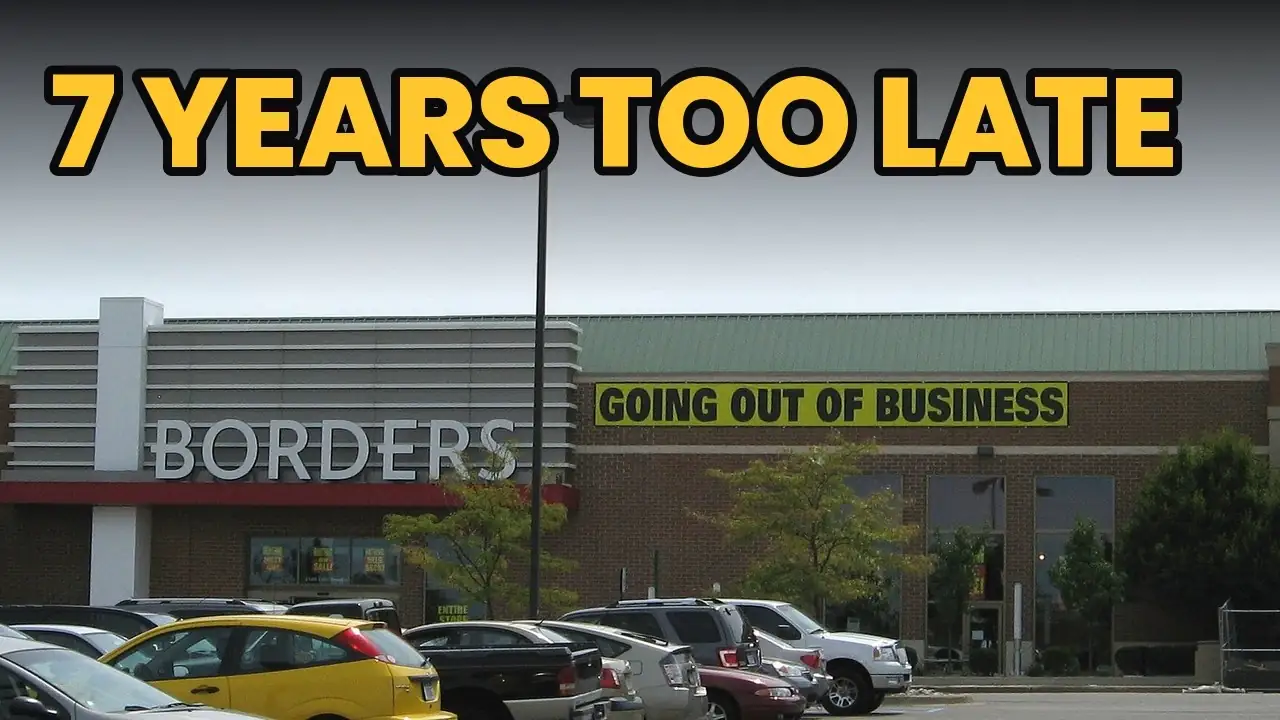
In 2007, Borders lost one hundred fifty-one million dollars. The next year it finally ended the Amazon deal and launched its own website. It had been seven years. Amazon now sold everything, and had the Kindle.
To stay alive, Borders borrowed forty-two million dollars from a hedge fund run by Bill Ackman. It changed chief executives again and again. Each new boss promised a turnaround.
Barnes and Noble launched its own e-reader, the Nook, in 2009. Borders did not have one until it partnered with a Canadian startup called Kobo in 2010. It was always one step behind, and the steps were getting bigger.
The collapse
On February sixteenth, 2011, Borders Group filed for bankruptcy in New York. It listed one point two eight billion dollars in assets, and one point two nine billion in debts.
The company said it would close about two hundred of its six hundred forty-two stores immediately, and roughly six thousand of its nineteen and a half thousand employees would lose their jobs.
Publishers, who were owed tens of millions of dollars for books on Borders shelves, refused to ship more. Without new books, a bookstore has nothing to sell.
For five months, lawyers searched for a buyer. A private investor made an offer, and it collapsed. Books-A-Million tried to save thirty stores, and that collapsed too.
On July eighteenth, 2011, Borders announced it would liquidate everything. Three hundred ninety-nine stores. Ten thousand seven hundred jobs. Going-out-of-business sales started that Friday.
The last Borders store closed its doors on September eighteenth, 2011. Barnes and Noble bought the Borders name and its customer list for about fourteen million dollars. Visitors to Borders dot com were redirected to its rival.
The other ending
Now here is the twist. Barnes and Noble faced exactly the same enemy, the same Amazon, the same Kindle, the same digital music, and it survived.
Barnes and Noble kept its website. It built its own e-reader. It had sold off its music sections early and signed shorter leases. Same storm, different boat.
And the independent bookstores Borders was supposed to crush? Many of them survived too. Small, cheap, local, and loved. The giant in the middle was the one that fell.
The verdict
The popular story is that Amazon killed Borders. But Amazon did not force Borders to hand over its website. It did not sign the leases, or stock the CDs, or wait seven years to build a store online.
Borders was built on a brilliant idea: use data to know what people want before they do. Then it gave that data away, to the one company that understood its value better than anyone.
Louis Borders, the brother who wrote the software, had left years earlier. He went on to found Webvan, an online grocery company that failed too. The family that invented data-driven bookselling never got to use it against Amazon.
Ann Arbor's flagship store, the one across from the university, held its final sale in the summer of 2011. Forty years after two brothers opened the doors, the shelves were empty.
So did Borders die because of Amazon? No. It died because it decided the internet was somebody else's problem, and paid that somebody to prove it wrong. By the time it tried to take the future back, the future already knew its customers by name.