Dead Companies
The full story
The keynote
In January 2007, an engineer in Waterloo watched a product launch on television. He had built the most successful smartphone in the world. The phone on screen was almost all glass, and it loaded full web pages. He later said he could not believe it.
His company was called Research in Motion, and its phone was the BlackBerry. Nearly half the smartphones sold in America were BlackBerries. Presidents, bankers, and celebrities could not put them down.
The popular story is that the touchscreen killed it. But BlackBerry's own numbers kept climbing for five more years after the iPhone. Something else was happening, and it had nothing to do with screens.
The pager
Research in Motion was founded in 1984 by two engineering students in Waterloo. For years it built modems, display boards, and wireless pagers. In 1999 one pager got a tiny keyboard and a radical feature: email.
Email that arrived on its own, anywhere, without dialing in. For an executive in 1999 this was magic. On Wall Street the device earned a nickname: the CrackBerry.
The secret was not the keyboard. It was a private network. Every message passed through BlackBerry's own servers, compressed and encrypted, which made it cheap on data and secure enough for banks and governments.
That network earned money every month, from every single device, paid by the phone companies. BlackBerry had built a toll road for the world's email, and the traffic kept growing.
The peak
By 2009, Fortune named it the fastest growing company in the world. It was the most valuable company in Canada. The new American president refused to give up his BlackBerry when he took office.
In its best year, fiscal 2011, the company brought in nearly twenty billion dollars. The number of subscribers would climb to around eighty million.
And then, with the business booming, the company made two decisions that look reckless only in hindsight.
The response
The first was the Storm, released in 2008 to fight the iPhone. Its touchscreen physically clicked when you pressed it. It was rushed, it was buggy, and it came back to the stores in enormous numbers.
The second was the PlayBook tablet in 2011. It shipped without an email app. BlackBerry, the email company, sold a device that could not do email on its own. It wrote off nearly five hundred million dollars.
In October 2011, the private network went down for three days, around the world. Millions of users discovered they could live without it. Many never came back.
The real enemy
But here is the twist. BlackBerry's real customer was never the person holding the phone. It was the IT department that bought the phone for them. BlackBerry sold to the boss.
Apple sold to the employee. Around 2010, employees started bringing their own iPhones to work and demanding their email on them. The IT departments gave in. The phrase was: bring your own device.
At the same moment, networks got faster and data got cheap. The compression that made BlackBerry's private network special stopped mattering. A free highway had been built beside the toll road.
BlackBerry had built a fortress around its customer. Then the customer changed. Every strength it had was a strength in a market that was ending.
The collapse
In January 2012, the two co-chief executives who had run the company together for twenty years stepped down. The new boss promised a complete reboot: new software and new phones, called BlackBerry ten.
It launched in January 2013, more than a year late. The flagship was the Z ten, a touchscreen phone that finally matched the iPhone of several years earlier. Reviewers were polite. The customers were already gone.
By September 2013 the company wrote off about nine hundred thirty million dollars of unsold Z ten phones and announced it would cut forty percent of its staff: four thousand five hundred people.
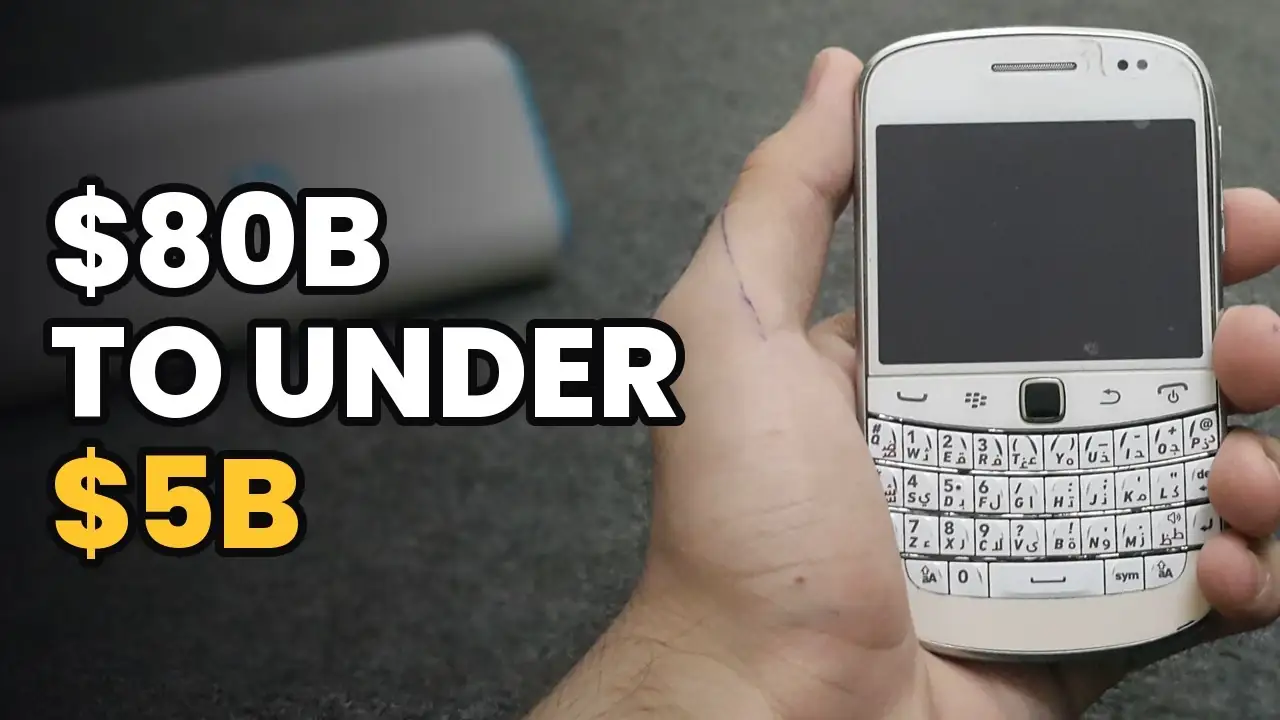
Shares that had traded above one hundred forty dollars in 2008 fell below seven. A company once worth more than eighty billion dollars was now worth less than five.
That same month, a Canadian insurer offered to buy the whole company for four point seven billion dollars. Six weeks later the deal fell apart. BlackBerry was for sale, and nobody wanted it.
Subscribers fell from a peak of around eighty-five million to twenty-three million by 2016. Global market share, once about twenty percent, fell to a rounding error.
The end
In November 2013 a new chief executive, John Chen, took over with one job: stop the bleeding. He tried an Android phone in 2015. Then, on September twenty-eighth, 2016, BlackBerry announced it would no longer make phones at all.
For a few more years a Chinese partner built keyboard phones under license. Then that ended too.
On January fourth, 2022, the company switched off the old network for good. Any classic BlackBerry still in a drawer stopped making calls that morning.
What remains of BlackBerry sells security software and the operating system running inside hundreds of millions of cars. It is small, it is quiet, and most people under thirty have never held one.
The campus in Waterloo was sold off building by building. At its height the company employed around seventeen thousand people. Within a few years of the collapse, it was down to about four thousand.
Even the phone companies that had once pushed a BlackBerry on every business customer moved on. The toll they had paid for years was money they would rather keep. The window displays filled with glass.
The verdict
One founder left in 2012. The other now funds quantum computing laboratories in Waterloo. The question they are still asked is the same: why did you not copy the iPhone sooner?
But the Storm was a copy. The Z ten was a copy. Copying was never the problem. The problem was that the customer who had made BlackBerry rich, the corporate IT department, stopped being the one who decided.
So did BlackBerry die because it ignored the touchscreen? No. It built touchscreens. It died because it sold to the boss, and one day every employee in the world stopped asking the boss for permission.