Dead Companies
The full story
The invention
In December 1975, a twenty-four-year-old engineer walked into a conference room at Kodak carrying a machine the size of a toaster. It weighed eight pounds, and it had just taken the first digital photograph in history.
His name was Steve Sasson. The image was black and white, one hundred pixels by one hundred pixels, and it took twenty-three seconds to record onto a cassette tape.
The executives looked at it, and gave him a verdict he never forgot. That's cute. But don't tell anyone about it.
Kodak had just invented the thing that would kill it. And then it put the invention in a drawer for twenty years. This is the story of how the most trusted brand in America photographed its own death.
The empire
To understand why, you have to understand how big Kodak was. In 1888, George Eastman sold the first Kodak camera with a slogan: you press the button, we do the rest.
For the next hundred years, Kodak did the rest for almost everyone. By 1976 it sold ninety percent of the film in America, and eighty-five percent of the cameras.
The real money was never the camera. Cameras were cheap. Film, developing, and paper were sold again and again, at margins of around seventy percent. Kodak was a razor company, and film was the blade.
At its peak, Kodak employed more than one hundred forty-five thousand people. In its hometown of Rochester, New York, it paid for hospitals, universities, and concert halls. Rochester was a company town, and the company was a giant.
In 1996, the company earned nearly sixteen billion dollars in revenue, and was ranked among the five most valuable brands on Earth, next to Coca-Cola and Disney.
The warning
Here is what makes the story painful. Kodak was not blindsided. It saw digital coming more clearly than anyone, because it was building it.
In 1981, after Sony announced an electronic camera, Kodak ran a massive internal study. The conclusion: digital would replace film, but Kodak had about ten years to prepare.
Ten years. That was the window. And the study said something else: the company that moved first would own the future of photography.
Kodak even patented the digital camera in 1978. For decades, it collected royalties from the competitors who actually built them. It literally got paid while it waited.
The trap
So why wait? Because every digital camera sold meant one less roll of film. And film was where all the profit lived.
Imagine telling your board: let's spend billions to build a product that earns a fraction of the margin, and destroys the business that pays all of our salaries. Every year, the rational choice was to wait one more year.
Economists have a name for this. The innovator's dilemma. Kodak is the textbook case, and it was written while Kodak was still alive to read it.
Half measures
To be fair, Kodak did try. In 1991 it released a professional digital camera, the DCS 100. It cost more than thirteen thousand dollars and needed a separate hard drive carried over the shoulder.
In 2001, it bought a photo-sharing website called Ofoto. Instead of letting people share photos online, Kodak used it to sell them prints. The film mindset, again.
Then, finally, in 2004 and 2005, Kodak went all in. Its EasyShare cameras became the best-selling digital cameras in America.
And it was losing money on every single one. Reports at the time put the loss at about sixty dollars per camera. Kodak had won the race to the bottom.
That same year, 2004, Kodak was kicked out of the Dow Jones Industrial Average after seventy-four years. Wall Street had already written the ending.
The phone
Then came the blow nobody could outrun. In 2007, the iPhone put a camera in everyone's pocket. Within a few years, most photos on Earth were taken on phones, and never printed at all.
Kodak's entire empire was built on paper, chemicals, and prints. The phone didn't just replace the camera. It erased the reason for film to exist.
Between 1988 and 2012, the workforce fell from more than one hundred forty-five thousand people to about seventeen thousand.
The collapse
On January nineteenth, 2012, Eastman Kodak filed for bankruptcy. It listed about six point seven five billion dollars in debts.
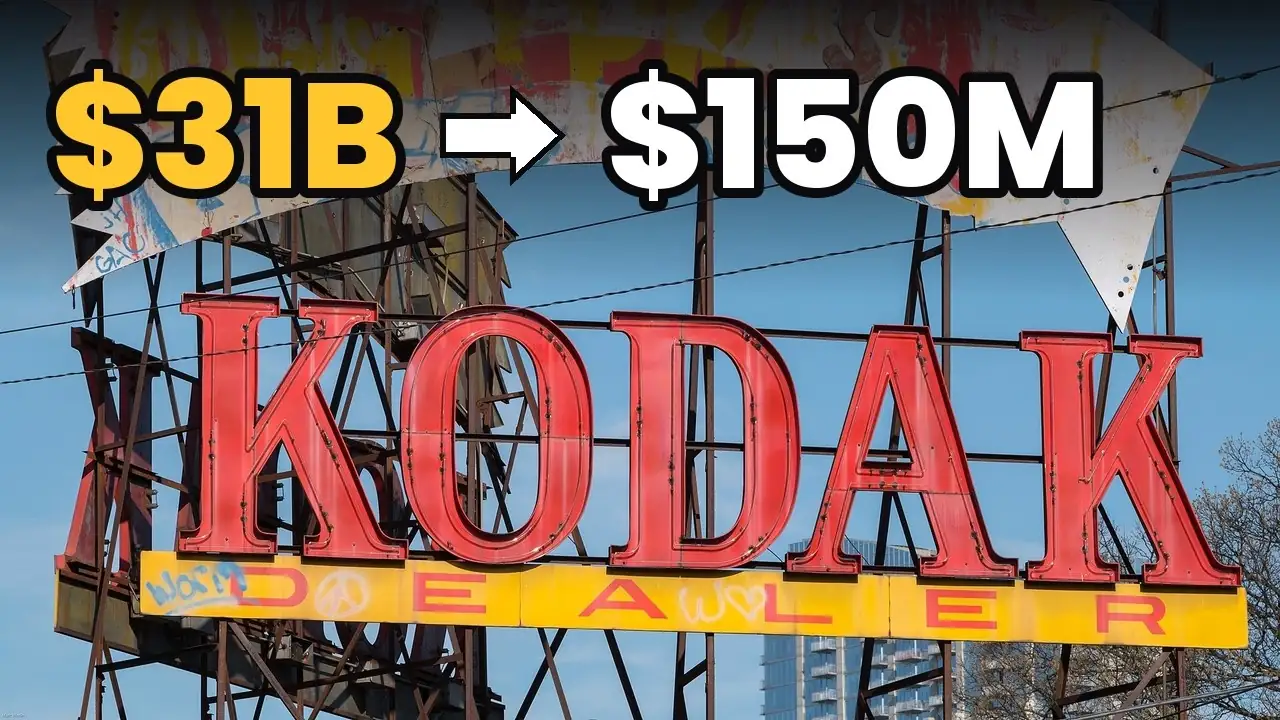
A company once worth around thirty-one billion dollars was now valued at roughly one hundred fifty million.
Three months later, Facebook bought a photo-sharing app called Instagram for one billion dollars. Instagram had thirteen employees and no revenue.
To survive, Kodak sold its crown jewels. The digital imaging patents, the ones from Steve Sasson's drawer, went for five hundred twenty-five million dollars to a group that included Apple and Google.
In 2013, what was left came out of bankruptcy as a commercial printing company. The film and photo business was handed to a British pension fund. The Kodak most people remember was gone.
The other ending
Now here is the twist. Kodak's biggest rival faced the exact same extinction, and lived.
Fujifilm saw the same cliff. But instead of defending film, it asked what else its chemistry could do. The answer was skincare, pharmaceuticals, and medical imaging. Today Fujifilm earns more than twenty billion dollars a year.
Same technology. Same warning. Same decade. One company asked how to protect the past. The other asked what the future needed.
The end
Steve Sasson was awarded the National Medal of Technology in 2009 for the camera his bosses told him to hide. Kodak went bankrupt three years later.
So did Kodak die because it missed digital? No. It invented digital. It studied digital. It patented digital. It died because the right decision was always one year away, until there were no years left.